Background
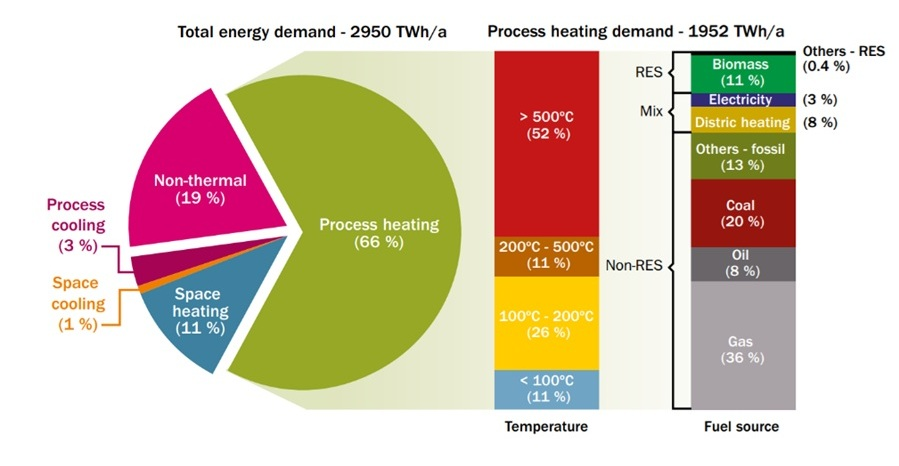
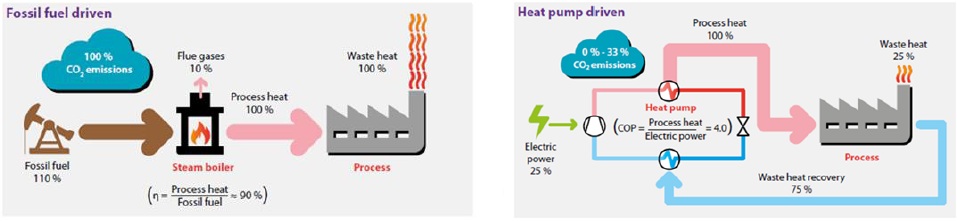
Industry accounts for a large share of Europe's final energy consumption, and most of that energy is used as process heat. Replacing fossil-fired heat with renewable electricity is therefore one of the most effective routes to industrial decarbonisation.
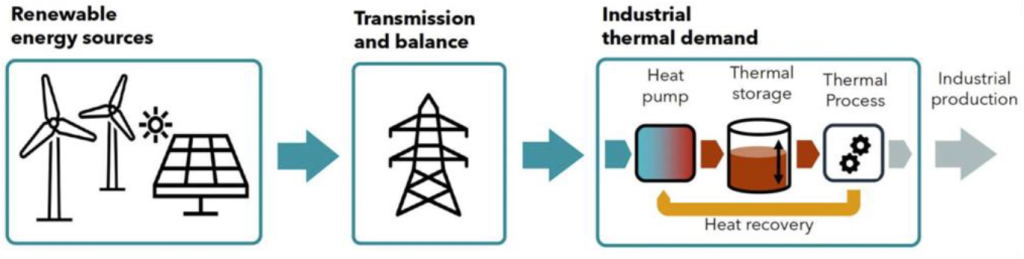
High temperature heat pumps (HTHP) can deliver process heat efficiently from renewable electricity, but renewable electricity is intermittent. Combining a heat pump with latent heat thermal energy storage (LHTES) decouples heat production from heat demand, so industrial processes can keep running on sustainable electricity from intermittent sources.
Aim
The aim of the CHASE project is therefore: to enable efficient integration of renewables providing heating of industrial processes by combining HTHP and LHTES at a relevant industrial scale.
Objectives
Demonstration and validation of a fully integrated HTHP/LHTES system
- The operation of a fully integrated HTHP/LHTES system at TNO providing 100 kW heat output with at least 50 K temperature lift, combined with a 100 kWh LHTES at 150°C
- The modeling of a virtually integrated system at DLR combining HTHP and LHTES at 250°C
- Demonstration of system’s performance meeting the design parameters through measurements, where the aim is to achieve >50% of Carnot efficiency (=fraction of theoretical maximum achievable heating output) and less than 5 K average driving force for fully charging LHTES within 1 hour
- Validation of model calculations being within 10% of measured system’s key performance indicators (efficiency, power output, temperature levels and thermal losses)
Determination business case analysis and market potential
- Investigation and definition of success criteria on next-generation technologies for a stable implementation of fully integrated systems in the long term
- Identification of most suitable applications for the combined system concept based on business-case analysis with and for industrial end users and equipment supplier(s)
- Identification of location-specific challenges and benefits of the combined systems for deployment in industry sectors such as food and building materials, via use cases provided by the industrial end users (Novo Nordisk and Trespa) and suppliers (StandardFasel) in the project consortium;
- Estimate application potential (# of units, expected sizes in MW and MWh) for combined systems for the individual countries present in the consortium as well as EU27
Environmental and societal benefits
- Determining the overall added value of the system, including environmental and societal benefits, compared to existing/alternative technologies (e.g. battery storage, direct electric heating, sensible heat storage).
References
- 1.IEA — Is the European Union on track to meet its REPowerEU goals?
- 2.SINTEF — Industrial heat pump white paper
- 3.Eurostat
- 4.TNO — Estimation of the European market potential
- 5.Heat Pumping Technologies Magazine, Vol. 41 no 1/2023